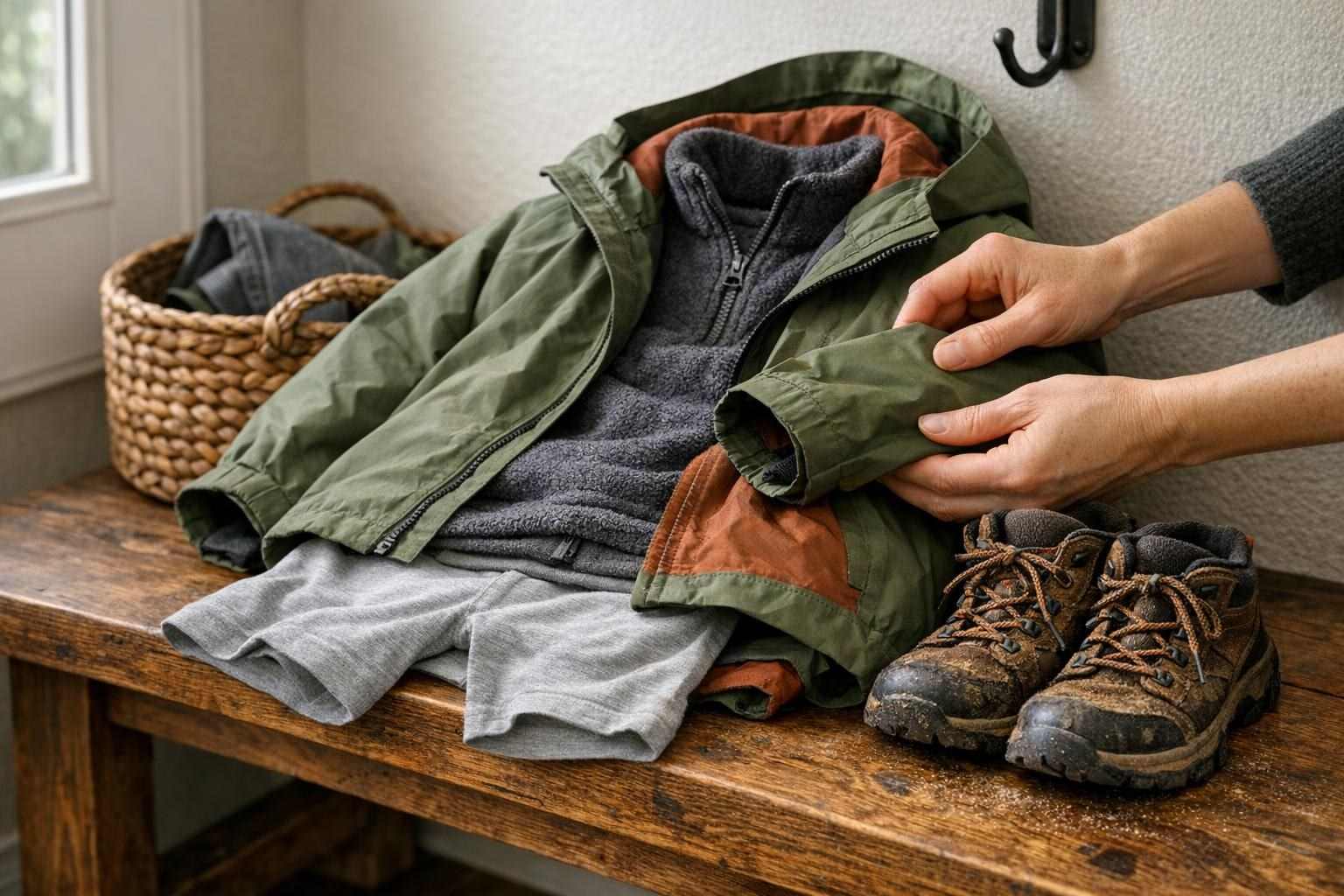
We try to maintain a household where there is plenty of clothing for everyone, but often the useful pieces are scattered, buried, damp or too small. A calm seasonal sort of items can save lots of time and hassle in the run-up to a weekend's hiking, hunting or camping and ensures children are suitably dressed for changing conditions. And, it has to be said, sensible outfitting of a family does not have to include the construction of a perfect wardrobe. Just sorting out what actually works for your family, separating out the decent layers from the bulk of the less useful gear and ensuring that for each outing the necessary items are readily to hand.
Start with one clear sorting zone
Choose a dry floor space such as a bench or table and sort out all of each person's clothing for the upcoming season such as base layers, mid layers, outer shells, trousers, hats, gloves, socks and boots.Include clothing that is used for very rough outdoor work. List the 4 categories of clothing for each person and fill each category with the appropriate articles.
Be honest about clothing that others may want and that you are unsure about. Remember that just because something is faded does not mean it should be thrown away. However, items with broken closures, thinning seats or with an odor that will not come out even after washing may affect how the clothing is used. Do not confuse sentimental value with functional value. Remove all sentimental items from the working piles to consider them separately.
Organize clothing into complete outfits for various activities. There are several different types of outdoor adventures and each activity requires different clothing layers for optimal comfort. Seeing that you have useful clothing layers as opposed to many pieces of clothing can help expose the absence of small items needed for warmth such as dry gloves or extra pair of socks.
Check fit before judging condition
Children grow very fast. Even perfectly good hiking clothing can get too small within a few seasons of wearing. Be brutal when testing clothing for others for fit. Ask children to show off their clothing for you to try on. Test for movement by asking children to squat down, to raise their arms above their heads, to take a few steps. Clothing that forces children's sleeves up, that makes a bulge in the waistband, that rides up over children's ears and obscures their vision when wearing the hood, must be removed from the ready pile.
While a little extra room in a layer is helpful for insulation, very loose clothing can be a problem. For example, loose cuffs can get caught in branches, long loose trousers can get muddy and be a pain to walk in, and a very large hood can move about when trying to look around. Similarly for adults, layers for activities such as hunting or work can have extra room but this can create problems of noise, bulk and being unable to roll up sleeves, etc. and secure in place.
Give footwear equal consideration. Check the soles, heels, toes, upper material, laces, tongue, cushioning and any seams or areas where water could enter. If children wear socks with their boots, test the footwear with those specific socks. Remember that a thicker sock won't necessarily solve a too-tight fit and could even create cold spots. Also make sure that children are able to put on and take off their own footwear quickly and easily if needed when out and about.
Build layers around the day's work
Outdoor layering is best when each layer serves a purpose. The next-to-skin layer keeps you dry to minimize need for bulk. The mid-layer keeps you warm. The outer layer protects from wind, rain, brush and dirt. Not all activities or people need the same number of layers and their weight.
Consider the activity that the child will be doing and adjust the layering to meet the demands of that activity. For example a child walking slowly on a smooth path may need less insulation than a child sitting around a camp site. A child carrying a heavy pack whilst walking through cover may overheat whilst walking but cool down rapidly when stopped.
Be mindful of those who may need to change quickly for cooler weather, but avoid bringing identical items for each family member. Shell, socks, and hats are typically the items that can be most easily added to a person's layering system. Additionally, clothing that can be easily compressed for storage in a vehicle or in a day pack is far better than bulky items. Store heavy items such as ski pants at camp or in a gear tote.
Also think about changing between activities, as a damp short-sleeved base layer may get cold very quickly once you stop walking, and so will need to be changed for a dry one. For activities such as hunting or quiet observation, the fastenings on garments such as rainwear, hats and gloves must not produce any unnecessary noise that could alert prey to your presence, or get caught in vegetation.
Repair the small failures now
The majority of minor faults can be repaired at the time of seasonal sorting for field problems to be averted. Wash items according to the garment's care label and allow to dry completely before inspecting for lost items such as wash wrappers, dirty gloves etc and brushing off any dirt from zippers etc to check for smooth closure. Check for loose seams, missing buttons, stretched elastic and any small tears to knees and cuffs of lower garments etc.
A simple patch to a basic layer of fleece may be adequate for items to be used for camp chores however, the same repair to a waterproof shell could have serious consequences as even a very small hole could allow water to enter when wet. Any repair that affects visibility, mobility or the close fit of items such as hoods and cuffs would be better to replace the item entirely and get a professional repair done.
Do not store clothing that has been washed in a tight roll or wet. Allow clothing that has been washed to dry and then fold or hang as necessary. Look up the care of special fabrics such as technical outer layers, insulating layers and waterproof outer layers. Avoid washing or drying these types of clothing using methods that could cause them to deteriorate.
The recording of repairs that need supplies or possibly professional assistance can be done by means of a simple note attached to the clothing item. This note can then be referred to by the owner of the clothing item next season when it is brought out again. It can also be a good way of avoiding re-discovering the same item in the same state of unfinished repairs.
Make seasonal gear easy to find
Camping gear can be organized in broad categories labeled around the outside of bins or on shelves such as "rainwear", "warm layers", "footwear", etc. The most used items should be stored at the highest point of the room and children's small accessories such as hats, gloves, etc. should be stored together in one place so that if one item is lost the others can easily be found.
Be sure to separate clean gear ready to go from items that need repair or washing. Breathable bags or open shelving are great for storing clothing, as opposed to storing in sealed containers where clothing may become wet. Store boots upright with pairs together. Try to keep items such as hats and gloves on top of clothing rather than underneath it.
Do one final check before leaving
This short check could reveal items that have not been included in your sort (e.g. that hat and that pair of gloves you thought were in that pullover could be hung on the clothesline now), and it means you can reassess your layers for that particular weather forecast or for the ground conditions you expect to encounter on the first of your outdoors activities.
Be aware that for outdoor activities like hunting, camping, etc. there can be restrictions concerning clothing and gear. Check out the official web pages for the area you'll be in for up-to-date information. Our seasonal check up is about one thing: having good enough clothing for outdoors activities and being able to put layers on quickly when it starts to get wet and cold.